The study methods with the strongest evidence are practice testing (quizzing yourself from memory) and spaced practice (spreading reviews over days). Interleaving, self-explanation and asking yourself "why" come next. Rereading, highlighting and copying notes feel productive but rank lowest. A good week of studying uses two or three of the strong methods together, not all twelve.
That ranking is not a matter of taste. In 2013 a team of psychologists led by John Dunlosky reviewed hundreds of studies on ten common techniques and rated each one high, moderate or low for students. Only two got a high rating. The most popular habits among students landed at the bottom. Below you get the full list, what each method is good for, and how to use it this week.
| Method | Evidence | Best for | Time cost |
|---|
| Practice testing (active recall) | High | Anything you will be tested on | Low to medium |
| Spaced practice | High | Long-term memory, cumulative exams | Low, needs a calendar |
| Interleaving | Moderate | Math, physics, problem types you mix up | Medium |
| Self-explanation | Moderate | Worked examples, proofs, processes | Medium |
| Elaborative interrogation ("why?") | Moderate | Facts that need a reason attached | Low |
| Feynman technique | Builds on self-explanation | Concepts you only half understand | Medium |
| Blurting | Builds on practice testing | Checking a chapter after reading it | Low |
| Leitner system | Builds on testing plus spacing | Vocabulary, definitions, formulas | Low once set up |
| SQ3R | Mixed, depends on the recall step | Dense textbook chapters | High |
| Pomodoro technique | Focus aid, not a learning method | Getting started, long sessions | None |
| Summarizing | Low as usually done | First pass on new material | Medium |
| Rereading and highlighting | Low | Almost nothing on its own | Low, but wasted |
"Builds on" means the method has not been rated as its own technique, but its core step is one that has. The Feynman technique is self-explanation with a stricter test. Blurting is practice testing on a blank page.
1. Practice testing (active recall)
Practice testing means pulling the answer out of your memory before you look at it. Flashcards, practice questions, past exams and closing the book to answer a question all count. It is the single most reliable method in the research. In a well-known 2006 experiment by Roediger and Karpicke, students who reread a passage did better on a test five minutes later, but students who had tested themselves remembered more one week later. The effort of recalling is what makes it stick.
How to do it:
- Turn each heading or lecture slide into a question.
- Answer it with your notes closed, out loud or on paper.
- Check the answer and mark what you missed.
- Come back to the missed ones first next time.
More detail in our glossary entry on active recall and the short answer on how to do active recall. If you build your own cards, the flashcard template is a good start.
2. Spaced practice
Spaced practice means studying the same material in several short sessions spread over days instead of one long block. Four 30-minute sessions over a week beat two hours the night before, even though the total time is the same. Each time you come back, you have forgotten a little, and recalling it again rebuilds the memory stronger.
A simple schedule: first review one day after you learn something, then after three days, then after a week, then after two weeks. Put the dates in your calendar right away, or use a study plan template. The glossary entry on spaced repetition explains why the gaps grow.
Practice testing and spacing work best together. Test yourself, and spread those tests out. That combination alone covers most of what "studying smarter" means.
3. Interleaving
Interleaving means mixing different topics or problem types in one session instead of doing twenty of the same kind in a row. In math it looks like solving a derivative, then an integral, then a limit, instead of a block of each. It feels slower and you make more mistakes during practice, but you get better at the thing exams test: recognizing which method a problem needs. It helps most when the topics are easy to confuse.
4. Self-explanation
While you read a worked example or a proof, explain each step to yourself. Why does this line follow from the last one? What rule was used? Students who do this understand procedures better than students who just read the solution. It costs time, so save it for the parts you would otherwise copy without understanding. See self-explanation.
5. Elaborative interrogation
This is asking "why is this true?" about a fact and answering it. "Why do enzymes stop working at high temperatures?" forces you to connect the fact to what you already know. It works well for factual material in biology, history and economics. It is cheap: one extra question per fact. The broader idea is called elaboration.
6. Feynman technique
Pick a concept, explain it in plain words as if to a 12-year-old, notice where you get stuck or reach for jargon, then go back to the source and fill that gap. The Feynman technique is self-explanation with a built-in test: if you cannot say it simply, you do not know it yet. Use it for the two or three concepts per chapter that feel fuzzy.
7. Blurting
Read a section, close everything, and write down all you remember on a blank page for five to ten minutes. Then open the book and fill in what you missed in a different color. The gaps are your next study list. Blurting is the fastest way to check a chapter right after you read it.
8. Leitner system
The Leitner system sorts flashcards into boxes. Box 1 is reviewed every day, box 2 every few days, box 3 once a week. A card you get right moves up one box. A card you get wrong goes back to box 1. It is spaced practice and testing on paper, which is why it works. Apps like Anki automate the same idea.
9. SQ3R
SQ3R stands for Survey, Question, Read, Recite, Review. You skim the chapter, turn headings into questions, read to answer them, recite the answers from memory, then review. The value sits almost entirely in the Recite and Review steps, which are practice testing. If you skip those, it turns into slow rereading. Our answer on how to study from a textbook shows a lighter version.
10. Pomodoro technique
Work for 25 minutes, take a 5-minute break, and after four rounds take a longer break. The Pomodoro technique does not make you learn better by itself. It makes you start, and it stops long sessions from turning into scrolling. Pair it with one of the methods above, for example one Pomodoro of practice questions.
11. Summarizing
Writing a summary got a low rating in the review, mostly because students do it badly: they copy sentences instead of compressing ideas. A summary in your own words, written from memory and then checked, is much closer to practice testing. Our guide on how to write a summary shows how.
12. Rereading and highlighting
These are the two most common habits and two of the weakest. Rereading makes the page look familiar, and familiarity feels like knowing. Highlighting marks what matters but does nothing to help you recall it later. Fix: highlight only on the first pass, then turn every highlight into a question you answer with the page covered.
The same goes for cramming. One long session the night before can get you through tomorrow's test, but most of it is gone a week later, which hurts on finals.
You do not need all twelve. A plan that works for most courses:
- After each lecture (10 minutes): blurt what you remember, then fix the gaps.
- Once a week (30 to 60 minutes): practice questions on this week's topic and one older topic, mixed together.
- Daily (10 to 15 minutes): flashcards for terms and formulas, with the misses first.
- Two weeks before the exam: a full practice test under timed conditions, then study only what you got wrong.
- Throughout: use self-explanation or the Feynman technique on anything you got wrong twice.
If you want a short version of this, the answers on the best way to study and how to study effectively sum it up in a few lines.
Preparing for one specific exam? Our guide on how to revise applies these methods to the weeks before a test.
"Learning styles" (visual, auditory and so on) is a popular idea, but studies have not found that matching your study method to a preferred style improves results. What matters more is the subject and the exam:
- Vocabulary, definitions, anatomy: flashcards with spacing (Leitner or an app).
- Math, physics, chemistry problems: practice problems, mixed by type, plus self-explanation of worked examples.
- History, biology, law: elaborative "why" questions and blurting after each chapter.
- Essay exams: outline answers to likely questions from memory, then check against your notes.
- Multiple choice: practice questions that look like the real ones, with explanations for every wrong option.
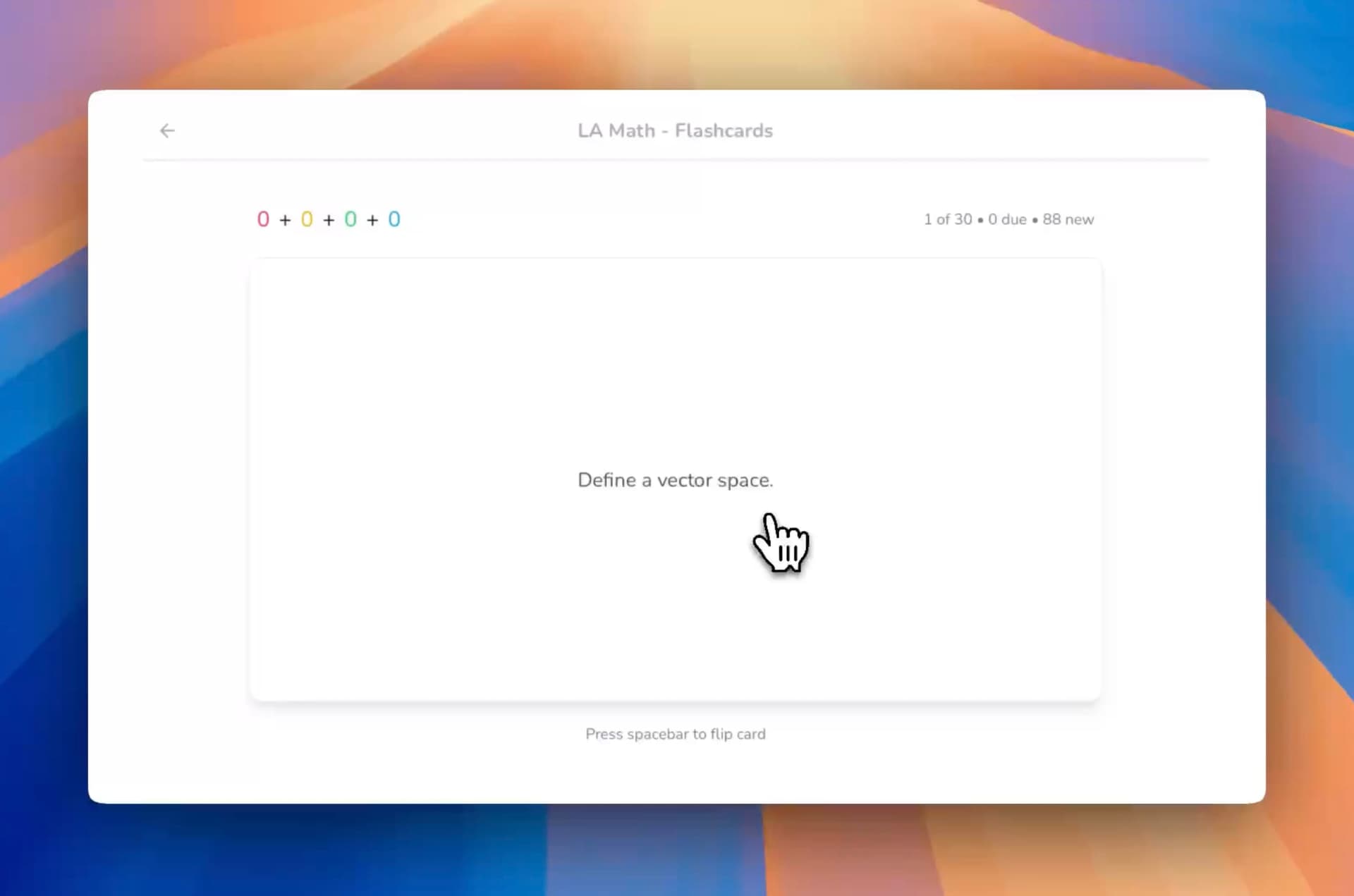
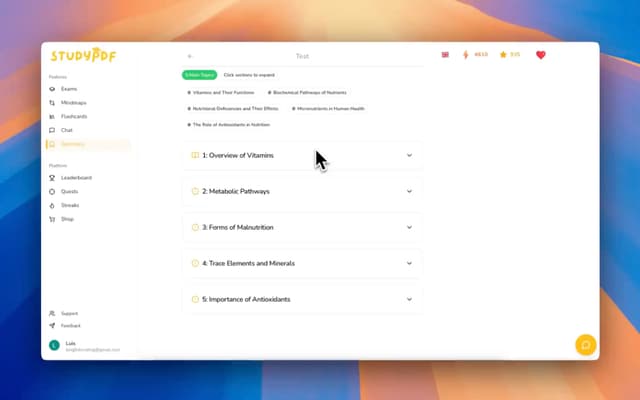
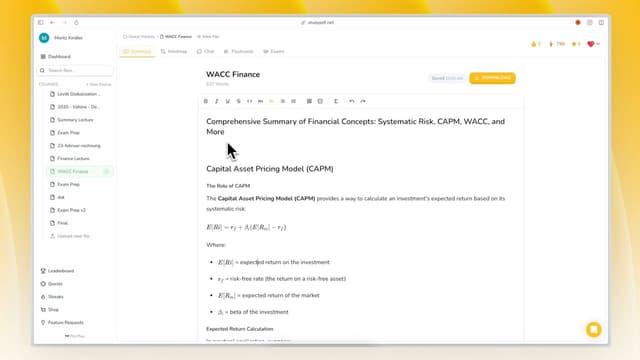
The hard part of practice testing is making the questions. That is the part StudyPDF does. You upload your own lecture slides, notes, documents or a photo of the whiteboard, and it builds practice quizzes and flashcards from that material. Every question cites the page it came from, so you can check the source when you get one wrong.
Each answer you give is tracked per concept, so after a few rounds you can see which topics are weak and make the next quiz from those. In the course's Plan tab you set your exam date, the hours you have and the days you study, and you get a dated revision plan that puts weak topics earlier and repeats them, which is spacing done for you. You can export flashcards to Anki if you already use it.
It is one option. Paper flashcards and a calendar work too. On the Free plan you can make about four materials a week, enough to try it on one course.
What is the most effective study method?
Practice testing, meaning quizzing yourself from memory, has the strongest evidence. Combined with spaced practice, so you test yourself again after one day, a few days and a week, it beats rereading and highlighting by a wide margin in most studies.
What are the 4 main study methods?
There is no official list of four. If you only use four, pick practice testing, spaced practice, interleaving and self-explanation. They are the four with high or moderate ratings in the best-known research review that also work across most subjects.
How long should I study each day?
For most students, one to three focused hours on school days is enough if the time goes into testing yourself rather than rereading. Short daily sessions beat rare long ones. Use 25 to 50 minute blocks with breaks.
Do study methods work for everyone?
The strong methods work across ages and subjects in the research, but how you apply them should fit the subject. Problems need practice problems, facts need recall and spacing, and essays need practice outlining answers from memory.