To write a summary, read the text once for the main idea, read it again and mark the few points that support it, then write a short version in your own words. Start with one sentence that names the title, the author and the main idea. Follow with the key points in the original order. Leave out examples, quotes and your own opinion. For most texts, aim for about a quarter to a third of the original length, or less for long works.
That is the whole method. The rest of this guide shows how to do each step well, how the format changes for an article, a textbook chapter, a book or a lecture, and what a finished summary looks like.
A summary is a shorter version of a text that keeps only its main idea and the points that hold it up, written in your words. It tells a reader what the author said, so they understand the text without reading it.
It is not:
- A paraphrase. A paraphrase restates one passage in different words at roughly the same length. A summary compresses the whole text.
- A review or a response. Your opinion of the text does not belong in a summary unless the assignment asks for it.
- A list of copied sentences. If you could highlight your summary in the original, it is not a summary yet.
For the term itself and why it helps memory, see summarizing in our glossary.
1. Know what the summary is for
A summary for an English class, a summary for your own exam notes and an abstract for a report are different jobs. Check the word limit and whether you need to name the author. For study notes, you can skip the formal opening and focus on the ideas you will be tested on.
2. Read the whole text once without marking anything
The first read is for the big picture. What is the author trying to say? In articles and essays the main idea is usually in the title, the first paragraph or the conclusion. In a textbook chapter it is in the headings and the chapter summary.
3. Write the main idea in one sentence
Before you go further, write one sentence that answers "What is this text about, and what does it claim?" If you cannot write it, read the introduction and conclusion again. Everything else in your summary hangs on this sentence.
4. Read again and mark the key points
Now mark the points that support the main idea. In a typical article there are three to five. Ask the 5 W's and H (who, what, when, where, why, how) if the text tells a story or reports events. For an argument, mark the reasons and the strongest evidence, not every example.
Keep your marking small. One short note in the margin per paragraph beats highlighting half the page. Our answer on how to annotate a textbook shows a simple system.
5. Cut what does not carry the idea
Cross out examples, anecdotes, repeated points, background detail, statistics that only illustrate, and direct quotes. They help the original persuade, but your reader does not need them to understand the point.
6. Write it in your own words
Close the text and write from your notes. This step matters most: writing from memory forces you to restate ideas instead of copying sentences. Start with your main idea sentence, then add the key points in the order the author made them. Use reporting verbs such as argues, explains, shows, concludes and suggests to make clear these are the author's ideas.
7. Check it against the original
Open the text again and ask three questions. Did I get the main idea right? Did I leave out a key point? Did I add anything the author did not say? Then check the length and fix grammar.
For an article or essay, this structure works almost every time:
- Opening sentence: In "[title]," [author] argues / explains that [main idea].
- Key point 1, with the reason or evidence in a few words.
- Key point 2.
- Key point 3 (and 4 or 5 if the text is long).
- Closing sentence: what the author concludes or recommends.
Write it as one paragraph for a short text, or one paragraph per major section for a long one. Use the present tense and the third person.
Example: a summary of a short article
Imagine a 600-word article titled "Why Students Forget What They Studied" by J. Rivera. It describes a student who reread her notes for hours and still failed, explains the forgetting curve, cites two experiments on self-testing, gives tips for using flashcards, and ends by recommending short review sessions spread over weeks.
A 90-word summary:
In "Why Students Forget What They Studied," J. Rivera argues that most students forget material because they study by rereading instead of testing themselves. Rivera explains that memory fades quickly after learning unless it is recalled again. Experiments show that students who quiz themselves remember more a week later than students who reread the same text. The article concludes that students should replace long rereading sessions with short self-tests spread over several weeks.
Notice what is missing: the student's story, the flashcard tips and the exact numbers. They make the article readable, but the summary works without them.
How to summarize different kinds of texts
How to write a summary of an article
Focus on the claim and the evidence. One paragraph of three to six sentences is enough for most news and journal articles. For the detailed version of this case, see our answer on how to summarize an article.
How to summarize a textbook chapter
Use the structure the author gave you. Turn each heading into one or two sentences, keep definitions of key terms, and skip the boxed examples. For study purposes, add one question per section that you can answer from memory later. The answer on how to take notes from a textbook pairs well with this.
How to write a book summary
For a novel, cover the main characters, the central conflict, the turning points and the ending, in that order. One sentence per chapter is a good first draft, then cut it down. For a nonfiction book, find the thesis (usually in the introduction) and summarize one key idea per chapter. A one-page book summary is often 250 to 400 words, no matter how long the book is.
How to summarize a lecture or video
Lectures repeat themselves and wander, so summarize from your notes, not your memory of the whole talk. Within 24 hours, write the lecture's main question, the three or four answers it gave, and any definitions or formulas. The Cornell notes method builds a summary box into every page, and our note-taking template has one ready.
| Original | Typical summary length |
|---|
| A paragraph | One or two sentences |
| An article (500 to 1,500 words) | One paragraph, 75 to 200 words |
| A textbook chapter | Half a page to one page |
| A research paper | 150 to 250 words, like an abstract |
| A book | One to two pages, or one paragraph per chapter |
| A 60-minute lecture | Half a page |
If your teacher gives a word limit, that wins. These are rules of thumb, not rules.
- Starting with background instead of the main idea. Your first sentence should tell the reader what the text claims.
- Copying the author's sentences with a few words swapped. That is close to plagiarism and shows you did not process the ideas.
- Including your opinion. "The author makes a great point" belongs in a response, not a summary.
- Giving every point equal weight. The main idea gets the most space. Small examples get none.
- Changing the meaning. Check that you did not make the author's claim stronger or weaker than it is.
A summary you write from memory is one of the better ways to check your active reading. If you can write a clear summary of a chapter with the book closed, you understand it. If you cannot, you know exactly which part to reread. That is also why summarizing ranks low in study research when students just copy sentences, and much higher when they write from memory and check. More on that in our guide to study methods.
For exam review, a stack of one-paragraph chapter summaries makes a good base for a full study guide. The study guide template shows how to arrange them.
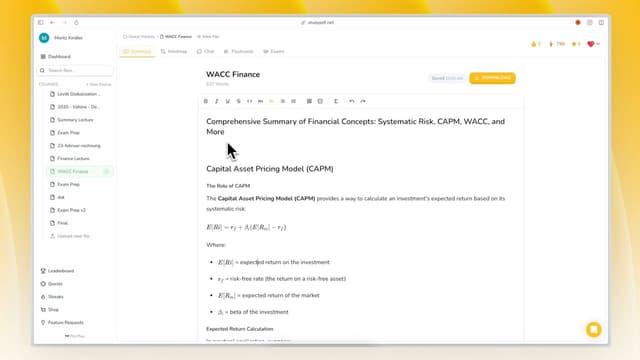
If you need a summary of your own course material to study from, StudyPDF can build one. You upload lecture slides, notes, documents or a photo of a page, and it creates an AI summary with a short TL;DR, the key points and a prose summary. Each point cites the page it came from, so you can check it against the source.
Use it as a starting point, not as your homework. For an English class, your teacher wants your own summary, and writing it yourself is what builds the skill. For revision, a cited summary next to your notes saves time, and you can turn the same material into practice questions to check that you remember it. The Free plan covers about four materials a week.
How do you start a summary?
Start with one sentence that names the title, the author and the main idea, for example: In "Title," Author argues that X. Do not open with background, a quote or your opinion.
What are the 5 parts of a summary?
A simple version: the title and author, the main idea, the key supporting points, the author's conclusion, and your own words throughout. Many teachers also expect present tense and no personal opinion.
Should a summary include quotes?
Usually not. A summary restates ideas in your own words. If one exact phrase is essential, you can quote a few words, but keep it rare and short.
How long should a summary be?
For most texts, about a quarter to a third of the original. Long works get compressed much more: a book can become one or two pages. A word limit from your teacher always comes first.