To get good grades, do four things all semester. Read the syllabus in week one so you know what each grade is made of. Put every exam and deadline in a calendar and plan your studying back from those dates. Study by testing yourself, not by rereading. Ask for help the first week you feel lost, not the week before the final. Students with good grades are rarely the ones who study the most hours. They are the ones who start early, never miss easy points and spend their study time on what they do not know yet.
Most advice on this topic is a list of tips. Below is a plan instead, organized by when in the semester you do each thing.
Read the syllabus like a contract
The syllabus tells you how your grade is calculated. Find three things for every class:
- The grade weights. A class might count the final for 40%, the midterm for 25%, homework for 20% and participation for 15%. That tells you where your effort pays off.
- The dates of every exam, quiz, paper and project.
- The policies: late work, retakes, extra credit, dropped lowest scores.
Students lose more points to things they did not know than to things they did not understand. A missed online quiz worth 2% is gone for good.
Build one calendar for everything
Put every date from every syllabus in one place, paper or app. Then work backwards: for each exam, block study sessions starting two weeks before. For each paper, set a date for the outline and a date for the first draft. The answer on how to make a study schedule and the study plan template help with this.
Find out where help lives
Write down your teacher's office hours, the tutoring center hours and how to reach a TA. You do not need them yet. You will want them fast when you do.
Go to every class and sit where you can focus
Attendance is the cheapest grade booster there is. Teachers often say what will be on the exam, and some grade participation. Sit near the front, away from friends you chat with, with your phone out of reach.
Take notes you can study from
Write down ideas in your own words, not every word the teacher says. Mark anything you did not understand with a question mark. Our answer on how to take good notes shows a simple format.
Review within 24 hours
Spend 10 to 15 minutes the same day or the next day going over the lecture. Better than rereading: close your notes and write down what you remember, then fill the gaps. This one habit means you are never learning a whole topic from scratch before an exam.
Do the homework, all of it, on time
Homework is often the easiest part of the grade to max out, and it is practice for the exam. Zeros hurt far more than low scores. A missing assignment pulls your average down more than a C would.
Use a weekly review
Every Sunday, spend 20 minutes on three questions. What is due this week? What did I not understand last week? Which exam is next, and what should I review for it? Then put those tasks in your calendar.
Studying more hours is not the same as studying well. The methods with the best evidence are:
- Active recall: test yourself from memory with flashcards, practice questions or a blank page, instead of rereading.
- Spaced repetition: review the same topic several times over days and weeks, not once in one long session.
- Practice tests: do questions that look like the real exam, under time pressure, then study what you got wrong.
- Past papers: if old exams are available, they are the closest preview of what you will be asked.
Highlighting, rereading and copying notes neatly feel productive but do little for your grade. Our guide to study methods ranks twelve techniques by the evidence behind them.
A plan that works for most tests:
| Days before the exam | What to do |
|---|
| 14 to 10 | List every topic. Rate each one: know it, shaky, no idea. |
| 10 to 5 | Practice questions on the shaky and no-idea topics first. |
| 5 to 3 | One full practice test under timed conditions. |
| 3 to 1 | Review only what you got wrong. Flashcards for terms and formulas. |
| Night before | Light review, then sleep. No new material. |
Cramming the night before can get you through tomorrow, but most of it is gone a week later. That hurts on finals, which are often cumulative. For the full process, see how to study for an exam.
The students who turn a C into a B usually do one thing differently: they go to office hours in week three, not week twelve. Bring a specific question ("I do not understand why this step works") rather than "I am lost." Teachers remember students who show up, and that can matter when your grade sits on a borderline.
Study groups help too, if the group actually quizzes each other instead of chatting. Explaining a topic to someone else is one of the fastest ways to find out you do not know it yet.
Sleep is when your brain consolidates what you learned that day. An all-nighter before an exam usually costs more points than it gains. Aim for a regular bedtime during exam weeks, not just normal weeks.
Procrastination is the other big grade killer. The fix that works for most people is making the first step tiny: "open the textbook and read one page" instead of "study chemistry." A 25-minute timer with a break after it helps you start.
- Check your current grade in every class and calculate what you need on the remaining work. Many students find the situation is better or worse than they thought.
- Talk to the teacher this week. Ask what you can still do: retakes, corrections, extra credit, a late submission.
- Submit every missing assignment the policy still allows, even for partial credit.
- Pick the one or two classes where effort will move the grade most, and focus there.
Our answers on how to catch up on schoolwork and how to raise your GPA go into the numbers.
Straight A's take the same plan, done without gaps. A few extra habits make the difference:
- Treat every small assignment as if it counts, because together they do.
- Go to office hours before major papers and ask what an A answer looks like.
- Start papers early enough to get feedback on a draft.
- Do every practice problem, not just the assigned ones, in your hardest class.
- Check your graded work for patterns in what you lose points on.
Straight A's are not always worth burning out for. A plan you can keep up all semester beats a perfect week followed by a crash.
Grades follow from a few habits that also make you learn more: being curious enough to ask questions, doing the reading before class, keeping your promises on deadlines, and treating mistakes as information instead of failure. Good students are not the ones who never get things wrong. They are the ones who find out early what they got wrong and fix it.
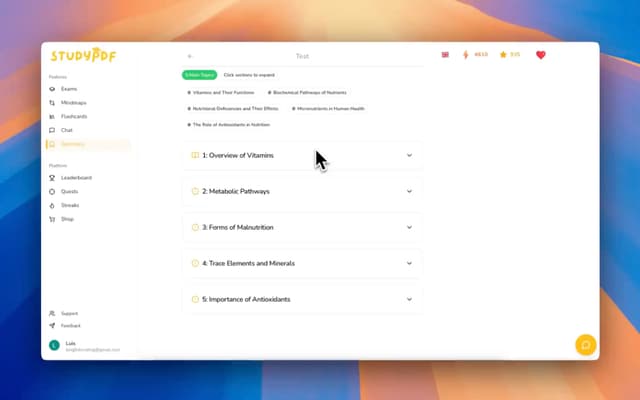
Two parts of this plan take the most effort: making a study schedule that matches your exam dates, and finding out what you do not know yet. StudyPDF helps with both, using your own course material.
You upload your lecture slides, notes or documents into a course. In the course's Plan tab, you enter your exam date, how many hours a day you have and which days you study, and you get a dated study plan with sessions up to the exam. A short placement check can calibrate the plan before you start, so topics you already know get less time and weak topics come earlier and repeat.
From the same material you can make practice quizzes and flashcards. Each answer you give is tracked per topic, so you see what is still shaky. On the Free plan you can make about four materials a week. A paper calendar and a stack of index cards work too. The habits matter more than the tool.
How can I get good grades fast?
Stop losing easy points first: turn in every assignment, check the syllabus for small graded tasks, and go to class. Then replace rereading with practice questions for your next test. Those changes show up within a few weeks.
How many hours a day should I study to get good grades?
Most students do well with one to three focused hours on school days, spread across subjects. How you study matters more than how long. An hour of self-testing beats three hours of rereading.
Is it too late to improve my grades this semester?
Usually not. Talk to your teacher this week, submit missing work the policy allows, and calculate what you need on the remaining exams. The more of the semester is left, the more you can change, so act now rather than after the next test.
Why do I study hard but still get bad grades?
Usually because the study time goes into rereading and highlighting, which feel productive but do not prepare you to recall answers on a test. Switch to practice questions and flashcards, and check whether you know a topic before you move on.