To improve reading comprehension, give every reading session three parts. Before you read, preview the headings and decide what questions you want answered. While you read, go one section at a time, write short notes in your own words and stop when something stops making sense. After you read, close the book, write down what you remember and explain it out loud. That last step is where most of the understanding happens, and it is the one most students skip.
This guide is written for high school and college students reading textbooks, articles and course readings. Below are 14 strategies in the order you use them, a quick way to test what you understood, and fixes for the problems that come up most.
Why you read a page and remember nothing
Most comprehension problems are not about intelligence or vocabulary. They come from reading passively: your eyes move across the lines while your mind is somewhere else. The page looks familiar afterwards, so it feels like you understood it.
Good readers do something different. They read with a question in mind, notice when they lose the thread, and check themselves at the end. Researchers call this monitoring your own understanding, a form of metacognition. All of it can be learned. For a definition of the skill itself, see comprehension in our glossary.
1. Know why you are reading
Reading for an exam, for a class discussion and for an essay are three different tasks. Write one line at the top of your notes: "I am reading this to..." It decides what you pay attention to.
2. Preview the chapter in two minutes
Skim the title, the headings, bold terms, diagrams, the first paragraph and the end-of-chapter summary or questions. You are building a map. When you read the details later, your brain has somewhere to put them.
3. Turn headings into questions
"The Causes of the French Revolution" becomes "What caused the French Revolution?" Now you are reading to find an answer, which keeps you focused. This is the Question step of the SQ3R method.
4. Ask what you already know
Take 30 seconds to recall anything you know about the topic, from class, earlier chapters or the news. New information sticks better when you connect it to something that is already there.
5. Read in chunks, not chapters
Read one section, usually between two headings, then stop. Long stretches without a break are where the zoning out happens. A chapter of 30 pages becomes eight or ten short sections.
6. Write margin notes instead of highlighting
After each section, write a few words in the margin or your notes that sum it up in your own words. Highlighting is easy to do without thinking. Writing a note is not. Our answers on how to annotate a textbook and how to take notes from a textbook show simple systems.
7. Stop at the first point of confusion
When a sentence stops making sense, do not push on and hope it clears up. Reread the paragraph, look at the diagram, or reread the previous section. Confusion builds: if you miss the definition on page 4, pages 5 to 10 will not make sense either.
8. Work out unfamiliar words from context, then check
Try to guess the meaning from the sentence around it, then look it up if the word matters. Keep a short list of key terms per chapter. Technical terms in a textbook are usually defined in the text or the glossary at the back.
9. Look at figures and tables properly
Students skip diagrams because they look slow. But in science and economics textbooks, the figure is often the clearest explanation on the page. Read the caption, find the axes or labels, and say in one sentence what it shows.
10. Slow down for hard texts
Speed is not the goal. Dense material like a primary source, a proof or a legal case needs a slower pace, sometimes two reads. For easier texts you can go faster. Our answer on how to read faster covers when speed helps and when it costs understanding.
11. Brain dump from memory
Close the book and write down everything you remember for five minutes: main ideas, terms, examples, how they connect. Then open the book and fill in what you missed in another color. This is the blurting method, and it shows you exactly what did not stick.
12. Teach it back
Explain the chapter out loud to a friend, a pet or an empty room, in plain words. Where you stumble or reach for the book's exact phrasing, you have not understood it yet. This is the core of the Feynman technique.
13. Write a short summary
Write three to five sentences on what the chapter was about and its main points, from memory. If you can do this, you understood the text. Our guide on how to write a summary walks through it.
14. Answer questions about it
Use the end-of-chapter questions, the questions you wrote from the headings, or practice questions from your teacher. Answer them with the book closed. A day or two later, answer them again. That second round is what moves the material into long-term memory.
| Strategy | When | What it fixes |
|---|
| Set a purpose | Before | Reading without knowing what matters |
| Preview and ask questions | Before | Getting lost in details |
| Read in chunks | During | Zoning out |
| Margin notes in your words | During | Passive reading |
| Stop when confused | During | Gaps that grow |
| Brain dump | After | Thinking you know it when you do not |
| Teach it back | After | Shallow understanding |
| Answer questions later | After | Forgetting by the exam |
These are the core active reading strategies. You do not need all of them every time. For a short article, previewing and a brain dump are enough. For a hard textbook chapter you will be tested on, use the full set.
A quick self-test after any reading:
- Can you state the main idea in one sentence without looking?
- Can you name the three or four key points that support it?
- Can you define the key terms in your own words?
- Can you explain how this chapter connects to the last one?
- Could you answer a question about it that you have not seen before?
If you answer no to two or more, go back to the sections you could not explain, not the whole chapter.
Zoning out every few paragraphs. Read shorter chunks and write one margin note after each. Put your phone in another room. Read at a desk, not in bed.
The vocabulary is too hard. Build a key-term list for the chapter before you start, using the bold terms and the glossary. Background knowledge matters too: reading an easier overview first, like an encyclopedia entry or an intro video, makes the hard text much easier.
You understand while reading but forget by the next day. That is normal. Understanding and remembering are different. Add the after-reading steps, then review the questions after one day and again after a few days.
You read too slowly to finish the reading. Preview first and read the parts that answer your questions closely. Skim the rest. Not every paragraph deserves the same attention.
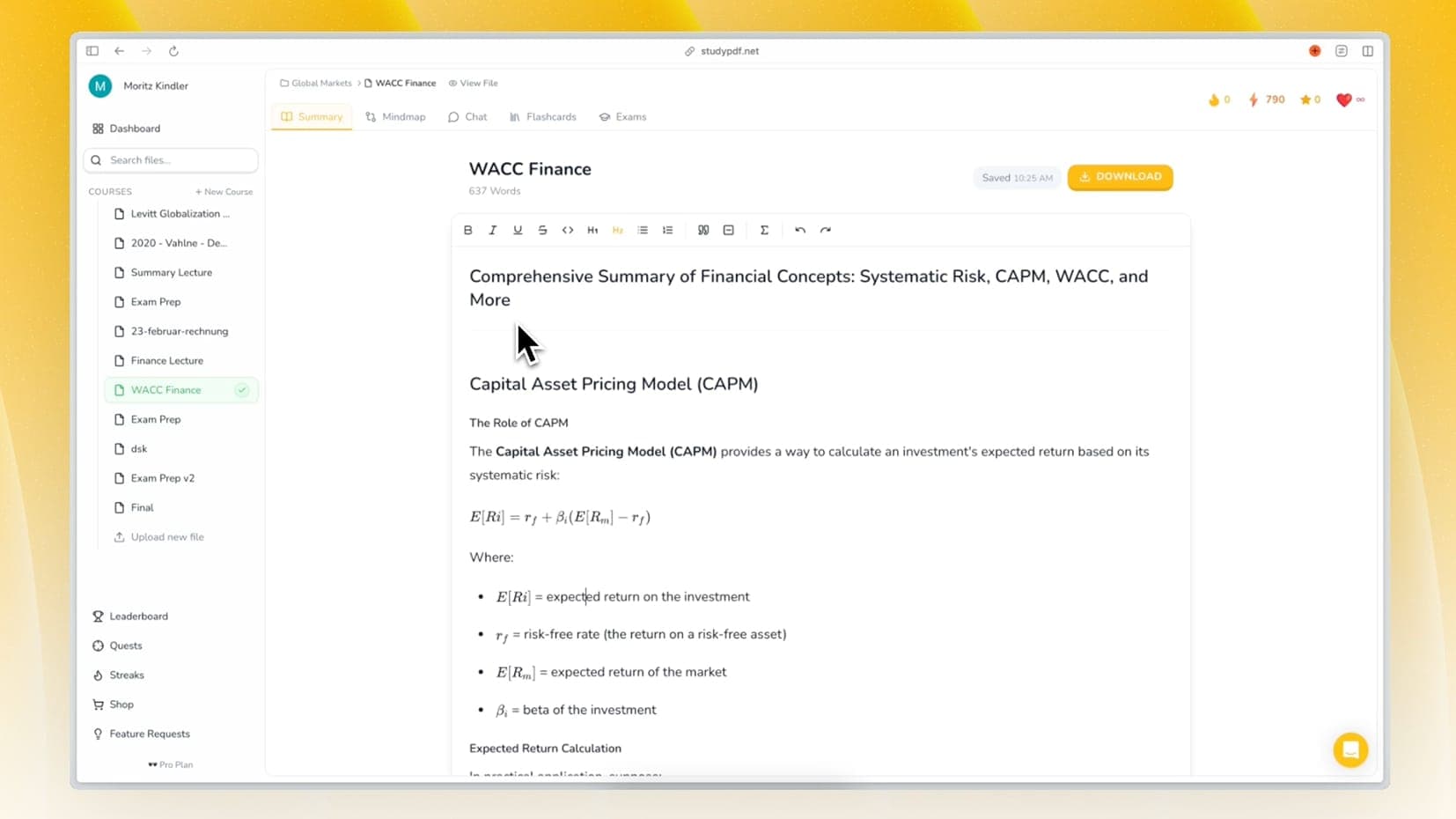
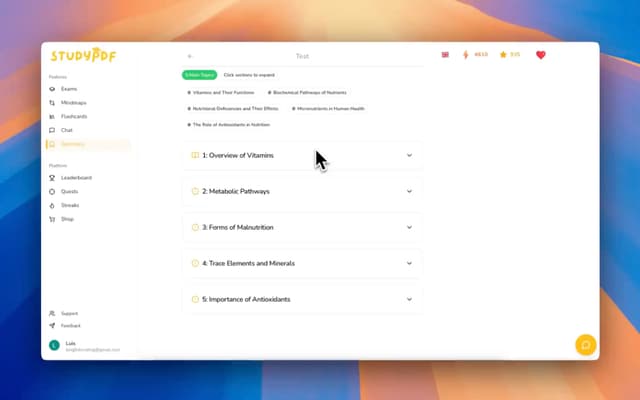
Step 14 is the one that is hardest to do on your own, because you need good questions about the exact chapter you read. StudyPDF can make them. You upload the chapter, your lecture slides or photos of the pages, and it builds practice questions from that material: multiple choice, short answer and fill-in-the-blank, with an explanation and the source page for each one.
When you get a question wrong, you can open the cited page and reread just that part, which is exactly the targeted rereading that helps. Your answers are tracked per concept, so the next set of questions can focus on what you did not understand. Use it after you have read the chapter yourself, not instead of reading it. The Free plan covers about four materials a week.
What are the 5 reading comprehension strategies?
A common set of five: previewing, asking questions, making connections to what you know, summarizing, and monitoring your understanding (noticing and fixing confusion). Together they turn reading from passive to active.
What is the 3-2-1 reading strategy?
After reading, you write three things you learned, two things you found interesting or want to know more about, and one question you still have. It is a quick way to process a text and works well for class readings.
How long does it take to improve reading comprehension?
Using these strategies helps from the first chapter, because they change how you read right away. Deeper gains in vocabulary and background knowledge take months of regular reading. Reading widely outside class speeds that up.
Does reading faster hurt comprehension?
For difficult material, yes. Speed reading techniques that skip words usually lower understanding. Reading faster works for easy or familiar texts. For textbooks you will be tested on, a steady pace with active steps beats speed.