The best way to revise is to test yourself, not to reread. Turn each topic into questions, answer them from memory, check what you got wrong, and come back to the weak bits a few days later. Do that on a timetable that starts weeks before the exam, finish with timed past papers, and you will remember far more than you would from hours of highlighting.
That is the short answer. The rest of this guide shows how to do it for GCSEs, A-levels or university exams: which revision techniques work and why, how to build a timetable you can stick to, and what to drop.
Rereading your notes feels productive because the material looks familiar. Familiar is not the same as remembered. In the exam you have a blank page and a question, so the skill you need is pulling the answer out of your own head.
A large review of learning techniques (Dunlosky and colleagues, 2013) rated ten common methods. Two came out on top: practice testing and spreading your study out over time. Highlighting, rereading and summarising came out near the bottom. Every technique below is built on those two winners.
If you want the theory in one line: revision works when it makes you retrieve information, and it works best when that retrieval is spaced out.
1. Active recall
Close the book and write down everything you know about a topic. Then open the book and mark what you missed. This is active recall, and it is the single most useful habit you can build. It is harder than reading, which is exactly why it works.
2. Blurting
Blurting is active recall on a timer. Pick one topic, such as the causes of the First World War or the stages of mitosis. Set five minutes and write everything you remember on a blank sheet. Check it against your notes in a different colour pen and fill the gaps. Repeat the same topic two days later and watch the coloured bits shrink.
3. Flashcards, used properly
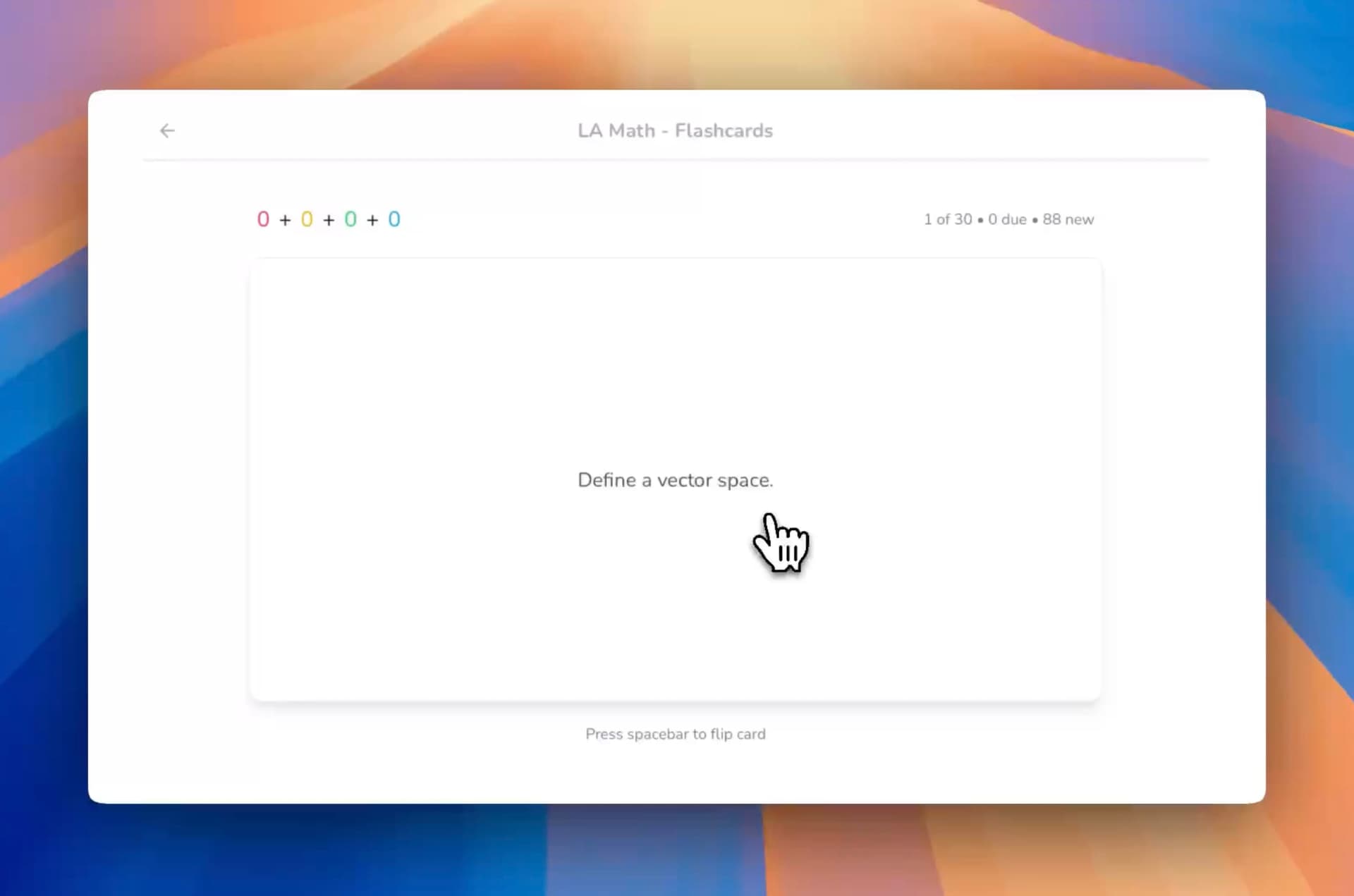
Flashcards work when the front is a question and the back is a short answer. "Define osmosis" beats a card with a paragraph on it. Say the answer out loud before you flip. Sort cards into three piles: knew it, slow, wrong. Revisit the wrong pile tomorrow and the knew-it pile next week. A flashcard template helps if you make them by hand.
4. Spaced repetition
Spread your revision of each topic over days and weeks instead of doing it all at once. This is spaced repetition. A popular version is the 2-3-5-7 method: revisit a topic on day 2, 3, 5 and 7 after you first revise it. The exact numbers matter less than the principle. Come back just as you are starting to forget.
5. Past papers and mark schemes
Past papers show you how questions are asked, how marks are split and which command words come up ("describe", "explain", "evaluate"). Do at least one paper per subject under timed conditions before the exam. Then mark it with the official mark scheme and note every place you lost marks. That list is your revision plan for the next week.
6. Interleaving
Mix topics within a session instead of doing one topic for three hours. In maths, do a mix of algebra, geometry and probability questions rather than 30 questions of the same type. Interleaving feels slower, but it trains you to recognise which method a question needs, which is what the exam tests.
7. Teach it
Explain a topic out loud to a friend, a parent or an empty chair, in simple words. Where you stumble is where you do not understand it yet. Go back to those points only.
8. Mind maps for the big picture
Mind maps are good for seeing how a topic fits together, for example how the themes, characters and context of an English Literature text connect. Draw one from memory first, then check it. A mind map you copy from a textbook is just colourful rereading.
9. Cue cards for essay subjects
For History, English or RS, write a cue card per likely essay question with three or four key points, a quote or date for each, and a one-line conclusion. Practise writing a full answer from the card in the time the exam gives you.
10. Short, focused blocks
Revise in blocks of 25 to 50 minutes with a 5 to 10 minute break, like the Pomodoro technique. Put your phone in another room, not face down on the desk. Three focused blocks beat a whole distracted afternoon.
11. Work on your weakest topics first
Most students revise what they already like, because it feels good. Rank your topics red, amber and green, and start each session with a red one. Use your past paper mistakes and quiz scores to decide, not your gut.
12. Sleep, food and fresh air
Sleep is when your brain stores what you revised that day. Aim for eight hours, especially in the week before exams. Late-night cramming trades tomorrow's memory for tonight's panic.
A timetable stops you from drifting and makes sure every topic gets spaced reviews. Here is a simple way to build one.
- List every exam with its date. Work backwards from the first one.
- Under each subject, list all topics from the specification. Your exam board publishes it.
- Rate each topic red, amber or green.
- Count the days you have and how many hours you can realistically revise per day. Two to three hours on a school day and four to six on a weekend or study leave day is a sensible range.
- Give each red topic at least three sessions, each amber topic two and each green topic one, spaced days apart.
- Put past papers in the last two to three weeks.
- Leave one evening a week free. You will need it to catch up.
You can start from our study plan template and fill in your own subjects. If a topic keeps coming up red, move it earlier and add another session.
How far ahead should you start?
For GCSEs and A-levels, most teachers suggest starting serious revision around Easter for exams in May and June, with lighter review from January. For university exams, three to four weeks of daily revision is a good target. If you only have a few days, the advice in how to review for an exam and how to study the night before an exam is a better fit.
Here is what one week could look like for a Year 11 student with six subjects, about six weeks before the exams.
| Day | Session 1 (40 min) | Session 2 (40 min) | Session 3 (30 min) |
|---|
| Monday | Biology: cell transport, blurting | Maths: mixed algebra questions | Flashcards: Spanish vocab |
| Tuesday | Chemistry: bonding, flashcards | English Lit: cue card, timed paragraph | Biology: redo blurt from Monday |
| Wednesday | History: Cold War causes, teach it | Maths: probability past paper questions | Flashcards: wrong pile only |
| Thursday | Physics: forces, practice questions | Spanish: speaking prompts | Chemistry: bonding quiz |
| Friday | Biology: past paper section, timed | Mark it with the mark scheme | Rest |
| Saturday | Maths: full past paper, timed | English Lit: essay plan from memory | History: blurt |
| Sunday | Free, or catch up | | |
Notice that every topic comes back within a few days, and every session asks you to produce something.
- Copying notes out neatly. It takes hours and tests nothing.
- Highlighting whole pages. If everything is yellow, nothing stands out.
- Revising with your phone next to you. Even a silent phone pulls attention.
- Only revising topics you already know.
- Leaving past papers until the last weekend.
- Making a beautiful timetable and never looking at it again.
StudyPDF is one option if you want to spend less time making revision materials and more time testing yourself. You upload your own class notes, slides, handouts or photos of your exercise book. StudyPDF splits them into topics and builds practice from them:
- Quizzes and flashcards from your revision notes, with each question linked back to the page it came from, so you can check the source.
- Practice exams that can be timed and only show feedback at the end, like a real paper.
- A Plan tab where you set your exam date, your hours and your study days. It lays out dated sessions up to the exam and puts your weakest topics first, then repeats them, which is spaced review without the spreadsheet.
Every answer you give updates how well you know each topic, so the next quiz focuses on what you keep getting wrong. The free plan covers about four materials a week. Try the AI quiz maker or build a study plan from your own notes. It does not replace past papers from your exam board, so keep doing those too.
What is the most effective way to revise?
Active recall combined with spaced repetition. Test yourself on a topic with questions, flashcards or blurting, check your mistakes, and revisit the same topic a few days later. Finish with timed past papers.
How many hours a day should I revise?
Two to three focused hours on a school day and four to six on a free day is plenty for most students. Quality matters more than hours. Three phone-free blocks of 40 minutes beat six distracted hours.
Is it better to revise in the morning or at night?
Revise when you can focus best, but do not cut sleep to fit it in. Many students find hard subjects easier in the morning and lighter review, like flashcards, fine in the evening.
How do I revise when I have no motivation?
Make the first step tiny. Set a timer for ten minutes and blurt one topic. Starting is the hardest part, and most people keep going once they have begun.
How long before an exam should I start revising?
For GCSEs and A-levels, start light review in January and full revision around Easter. For university exams, aim for at least three to four weeks of daily revision.