Label the Plant Cell
Tap a marker on the plant cell and pick the part it belongs to. There are ten markers, covering the wall and the membrane, the big central vacuole, the chloroplasts and the organelles a plant cell shares with an animal one. Start at the outside: the cell wall and the plasma membrane are two different layers, and telling them apart is half the battle.
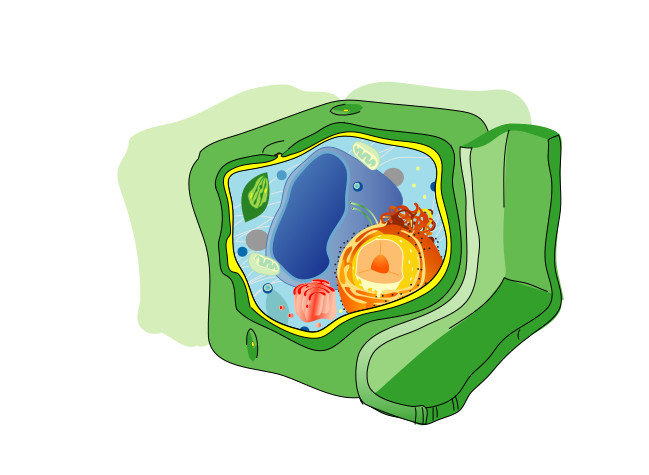
Pick the name of the highlighted marker.
All High School & Admission quizzes
- Labeling quiz · 10 labels
Label the Animal Cell
- Practice test · 15 questions
ASVAB Practice Test
- Practice test · 15 questions
GED Practice Test

Now make your own
Upload your prep book, slides or notes, or just tell Bo what you want to learn. You do not need a document to start.
All 10 labels on this diagram
Every marker on the figure is listed below with what it does. Answers stay collapsed until you open them, so you can quiz yourself as you scroll.
1. Cell wall
Show answer
The rigid outer layer, made mostly of cellulose. It gives the cell its box shape and stops it bursting when water floods in. Animal cells have nothing like it, which is the single most asked difference between the two.
2. Plasma membrane
Show answer
The thin layer just inside the wall, drawn here in yellow. This is the part that actually controls what enters and leaves. The wall outside it is porous and lets almost anything through, so the membrane does the choosing.
3. Cytoplasm
Show answer
The living contents between the membrane and the vacuole. In a mature plant cell the vacuole pushes it into a thin layer around the edge, which is why the organelles here are crowded against the outside.
4. Central vacuole
Show answer
The large sac of cell sap that fills most of a mature plant cell. Full of water it presses outwards and keeps the plant firm, and when it empties the plant wilts. Animal cells have only small, temporary vacuoles.
5. Chloroplast
Show answer
The green organelle where photosynthesis happens. The stripes inside are stacks of membranes holding chlorophyll, the pigment that absorbs light and gives leaves their colour. Root cells have none, since no light reaches them.
6. Mitochondrion
Show answer
Where respiration releases energy as ATP. Plants have mitochondria as well as chloroplasts, and they use them day and night, which is a point exam questions like to catch people out on.
7. Nucleus
Show answer
The control centre holding the cell's DNA. In a plant cell the vacuole usually pushes it out to the side rather than leaving it in the middle, exactly as it sits on this figure.
8. Nucleolus
Show answer
The dense region inside the nucleus where ribosomes are assembled. It is a part of the nucleus rather than an organelle in its own right, so it has no membrane around it.
9. Rough endoplasmic reticulum
Show answer
The folded membranes running off the nucleus, dotted with ribosomes. Those dots are what makes it rough, and they are where proteins for export get built.
10. Golgi apparatus
Show answer
The stack of flattened sacs that finishes and packages proteins into vesicles. In a plant cell it also assembles the carbohydrates that go into building the cell wall.
Cell wall or cell membrane, and why the difference matters
The two outer layers get mixed up more than anything else on this diagram, and the questions are written knowing that.
The cell wall is the thick outer layer made of cellulose. It is rigid, it is fully permeable, and its job is structural: it holds the shape and stops the cell bursting. The plasma membrane is the thin layer just inside it, drawn yellow on the figure. It is flexible, it is partially permeable, and its job is control: it decides what crosses.
That split explains what happens in water. Put a plant cell in pure water and it takes water in until the wall pushes back hard enough to stop it, and the cell becomes turgid rather than bursting. Put an animal cell, which has only the membrane, in the same water and it swells and bursts. Same membrane, different outcome, purely because of the wall.
The three parts only plants have
A plant cell has everything an animal cell has plus three extras, and almost every comparison question is really asking about those three.
The cell wall comes first. Then the chloroplasts, which do photosynthesis and are the reason plants make their own food. Then the large central vacuole, which is permanent and full of cell sap, unlike the small temporary vacuoles an animal cell sometimes has.
Going the other way, a plant cell normally has no centrioles. That is the one thing on the animal cell page that has no counterpart here.
Worth noticing on the figure: the vacuole is enormous. It squashes the cytoplasm and every organelle into a thin layer around the edge and shoves the nucleus off to one side. That is not the artist taking liberties, it is what a mature plant cell looks like, and it is why the nucleus in this drawing is nowhere near the middle.
How StudyPDF turns your own diagrams into labeling practice
One figure with ten markers will get you through a quiz. It will not get you through a test where the diagram is the one in your own textbook, drawn from a different angle, with the labels your teacher actually used.
StudyPDF works from your material instead. Upload the chapter, the lecture slides or the revision guide, and Bo, the study agent, builds practice from those exact pages, including the figures in them. Every explanation cites where the answer came from, so you can go straight back to the page when something looks off.
You do not need a file to start. Name a topic instead, for example photosynthesis and chloroplasts or plant and animal cell differences, and Bo builds practice from that. Starting is free.
Written by the StudyPDF team. Last updated 2026-08-19.