Etichetta l'apparato digerente
Le etichette restano in inglese.
Tocca un segnaposto sullo schema e scegli la parte che indica. I segnaposto sono undici e seguono il cibo dalle ghiandole salivari e dalla lingua giù per l'esofago, lo stomaco e l'intestino fino al retto, con fegato, cistifellea e pancreas lungo il percorso. La testa è aperta di lato e il torso è disegnato di fronte, quindi il fegato è a sinistra nell'immagine.
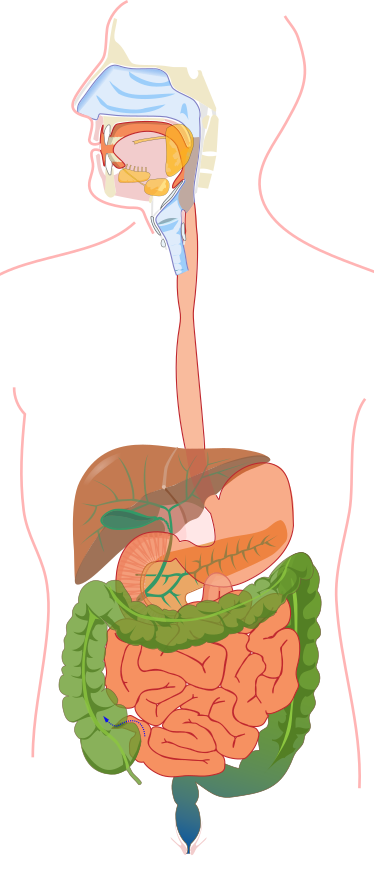
Scegli il nome del punto evidenziato.
Tutti i quiz di Infermieristica e salute
- Quiz di etichettatura · 11 etichette
Etichetta l'apparato respiratorio
- Quiz di etichettatura · 10 etichette
Etichetta lo schema del cuore
- Test di esercitazione · 15 domande
Test di anatomia e fisiologia

Crea il tuo
Carica il tuo libro, le slide o i tuoi appunti, oppure di' a Bo cosa vuoi studiare. Per iniziare non serve nessun documento.
Tutte le 11 etichette di questo diagramma
Qui sotto trovi tutti i segnaposto della figura e cosa fanno. Le risposte restano chiuse, così puoi interrogarti mentre scorri.
1. Salivary glands
Mostra la risposta
Three pairs of glands that make saliva: the parotid, submandibular and sublingual glands. The marker is on the yellow gland at the back of the mouth. Saliva moistens food and starts breaking down starch with the enzyme amylase.
2. Tongue
Mostra la risposta
A muscle that moves food around the mouth, pushes it against the teeth and shapes it into a ball called a bolus. It also carries the taste buds. When you swallow, it pushes the bolus back toward the throat.
3. Pharynx
Mostra la risposta
The throat, a muscular tube behind the mouth and nose. Air and food both pass through it, and swallowing sends the food on into the esophagus while a flap called the epiglottis keeps it out of the airway.
4. Esophagus
Mostra la risposta
The muscular tube that carries food from the throat to the stomach. It does not digest anything. Waves of muscle contraction called peristalsis squeeze the food down, which is why you can swallow even when you are lying down.
5. Liver
Mostra la risposta
The largest solid organ in the abdomen, on the right side of the body and so on the left of this picture. It makes bile, which helps digest fat, and it processes the nutrients that come in from the intestines. It also stores some of them, such as glucose in the form of glycogen.
6. Gallbladder
Mostra la risposta
A small pouch tucked under the liver. It stores and concentrates the bile the liver makes and squeezes it into the small intestine when a fatty meal arrives. You can live without it, because the liver keeps making bile.
7. Stomach
Mostra la risposta
A stretchy muscular bag that churns food with acid and the enzyme pepsin until it becomes a thick liquid called chyme. It empties a little at a time into the small intestine through a ring of muscle at its lower end.
8. Pancreas
Mostra la risposta
The orange band behind the stomach, drawn with its branching ducts. It makes digestive enzymes for starch, protein and fat and sends them into the small intestine, along with bicarbonate that neutralizes stomach acid. The same organ also makes the hormones insulin and glucagon.
9. Small intestine
Mostra la risposta
The long, coiled tube where most digestion finishes and nearly all nutrients are absorbed into the blood. Its lining is folded into tiny fingers called villi, which give it a huge surface area. It has three parts: the duodenum, jejunum and ileum.
10. Large intestine
Mostra la risposta
The wider tube, shown in green, that frames the small intestine on three sides. It absorbs water and salts from what is left and turns it into stool. The marker is on the ascending colon, which rises on the right side of the body; the transverse colon crosses the top and the descending colon runs down the other side.
11. Rectum
Mostra la risposta
The last section of the large intestine, the bluish bulb at the bottom. It holds stool until you are ready to pass it, and stretching of its wall is what creates the urge. The opening to the outside below it is the anus.
Segui un boccone e le etichette si mettono in ordine
L'apparato digerente è più facile da etichettare come un percorso, perché il cibo si muove in una sola direzione e quasi ogni segnaposto sta su quella strada.
Parte dalla bocca, dove denti e lingua spezzettano il cibo e le ghiandole salivari lo inumidiscono. La deglutizione lo porta attraverso la faringe e giù per l'esofago fino allo stomaco. Dallo stomaco entra nell'intestino tenue, poi nell'intestino crasso, e gli scarti escono dal retto e dall'ano.
Quella frase copre otto degli undici segnaposto, in ordine. Gli altri tre sono fegato, cistifellea e pancreas, dove il cibo non entra mai. Sono organi accessori: producono o conservano la bile e gli enzimi che vengono versati nell'intestino tenue perché la digestione possa finire lì.
Leggere questa figura: il disegno è appiattito
Due cose nell'immagine si leggono facilmente male. Prima, i lati. Il torso è rivolto verso di te, quindi il fegato sta a sinistra nell'immagine anche se appartiene al lato destro del corpo. Lo stomaco è a destra nell'immagine.
Seconda, la sovrapposizione. Gli organi veri stanno a strati e il disegno li mostra semitrasparenti. Il pancreas è la fascia arancione dietro lo stomaco, e le linee verdi ramificate sono i dotti che portano la bile e il succo pancreatico. Il colon trasverso, la fascia verde al centro, passa davanti all'intestino tenue. La piccola freccia tratteggiata in basso a sinistra, dove l'intestino tenue incontra il crasso, fa parte del disegno e non è un segnaposto.
Aiuta anche imparare l'intestino crasso come una cornice. Sale da un lato, attraversa la parte alta e scende dall'altro, ed è così che le tre etichette del colon si meritano il nome: ascendente, trasverso e discendente.
Come StudyPDF trasforma i tuoi schemi in esercizi di etichettatura
Una figura con undici segnaposto basta per un quiz. Un esame di anatomia o una prova di laboratorio useranno gli schemi del tuo corso, disegnati da un'altra angolazione, con i termini che si aspetta il tuo insegnante.
StudyPDF parte invece dal tuo materiale. Carica il capitolo, le slide della lezione o il manuale di laboratorio, e Bo, l'agente di studio, crea esercizi da quelle pagine esatte, comprese le figure che contengono. Ogni spiegazione indica da dove viene la risposta, così puoi tornare subito alla pagina.
Per iniziare non ti serve un file. Indica invece un argomento, per esempio le fasi della digestione o il ruolo della bile, e Bo prepara gli esercizi su quello. Iniziare è gratis.
Scritto dal team di StudyPDF. Ultimo aggiornamento 2026-08-19.