Identifique o sistema digestório
As legendas ficam em inglês.
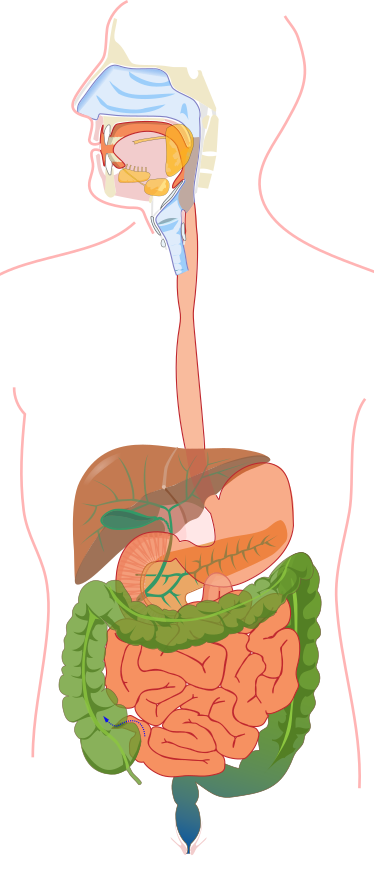
Toque em um marcador do diagrama e escolha a parte que pertence a ele. São onze marcadores, seguindo o alimento das glândulas salivares e da língua pelo esôfago, estômago e intestinos até o reto, com o fígado, a vesícula biliar e o pâncreas pelo caminho. A cabeça está cortada de lado e o tronco está desenhado de frente, então o fígado fica à esquerda da imagem.
Escolhe o nome do marcador destacado.
Todos os quizzes de Enfermagem e Saúde
- Quiz de identificação · 11 identificações
Identifique o sistema respiratório
- Quiz de identificação · 10 identificações
Identifique o diagrama do coração
- Simulado · 15 questões
Simulado de Anatomia e Fisiologia

Crie o seu
Envie seu livro, seus slides ou suas anotações, ou só diga ao Bo o que você quer estudar. Você não precisa de nenhum documento para começar.
Todas as 11 identificações deste diagrama
Abaixo estão todos os marcadores da figura e o que cada um faz. As respostas ficam recolhidas para você se testar enquanto rola a página.
1. Salivary glands
Mostrar resposta
Three pairs of glands that make saliva: the parotid, submandibular and sublingual glands. The marker is on the yellow gland at the back of the mouth. Saliva moistens food and starts breaking down starch with the enzyme amylase.
2. Tongue
Mostrar resposta
A muscle that moves food around the mouth, pushes it against the teeth and shapes it into a ball called a bolus. It also carries the taste buds. When you swallow, it pushes the bolus back toward the throat.
3. Pharynx
Mostrar resposta
The throat, a muscular tube behind the mouth and nose. Air and food both pass through it, and swallowing sends the food on into the esophagus while a flap called the epiglottis keeps it out of the airway.
4. Esophagus
Mostrar resposta
The muscular tube that carries food from the throat to the stomach. It does not digest anything. Waves of muscle contraction called peristalsis squeeze the food down, which is why you can swallow even when you are lying down.
5. Liver
Mostrar resposta
The largest solid organ in the abdomen, on the right side of the body and so on the left of this picture. It makes bile, which helps digest fat, and it processes the nutrients that come in from the intestines. It also stores some of them, such as glucose in the form of glycogen.
6. Gallbladder
Mostrar resposta
A small pouch tucked under the liver. It stores and concentrates the bile the liver makes and squeezes it into the small intestine when a fatty meal arrives. You can live without it, because the liver keeps making bile.
7. Stomach
Mostrar resposta
A stretchy muscular bag that churns food with acid and the enzyme pepsin until it becomes a thick liquid called chyme. It empties a little at a time into the small intestine through a ring of muscle at its lower end.
8. Pancreas
Mostrar resposta
The orange band behind the stomach, drawn with its branching ducts. It makes digestive enzymes for starch, protein and fat and sends them into the small intestine, along with bicarbonate that neutralizes stomach acid. The same organ also makes the hormones insulin and glucagon.
9. Small intestine
Mostrar resposta
The long, coiled tube where most digestion finishes and nearly all nutrients are absorbed into the blood. Its lining is folded into tiny fingers called villi, which give it a huge surface area. It has three parts: the duodenum, jejunum and ileum.
10. Large intestine
Mostrar resposta
The wider tube, shown in green, that frames the small intestine on three sides. It absorbs water and salts from what is left and turns it into stool. The marker is on the ascending colon, which rises on the right side of the body; the transverse colon crosses the top and the descending colon runs down the other side.
11. Rectum
Mostrar resposta
The last section of the large intestine, the bluish bulb at the bottom. It holds stool until you are ready to pass it, and stretching of its wall is what creates the urge. The opening to the outside below it is the anus.
Siga uma mordida e as legendas se organizam sozinhas
O sistema digestório é mais fácil de identificar como um trajeto, porque o alimento só anda em um sentido e quase todos os marcadores ficam nesse caminho.
Tudo começa na boca, onde os dentes e a língua quebram o alimento e as glândulas salivares o umedecem. A deglutição o leva pela faringe e esôfago abaixo até o estômago. Do estômago ele entra no intestino delgado, depois no intestino grosso, e o resíduo sai pelo reto e pelo ânus.
Essa frase cobre oito dos onze marcadores, em ordem. Os outros três são o fígado, a vesícula biliar e o pâncreas, onde o alimento nunca entra. Eles são órgãos acessórios: produzem ou guardam a bile e as enzimas que são despejadas no intestino delgado para que a digestão termine ali.
Como ler esta figura: o desenho é achatado
Duas coisas na imagem são fáceis de ler errado. Primeiro, os lados. O tronco está de frente para você, então o fígado fica à esquerda da imagem, embora pertença ao lado direito do corpo. O estômago fica à direita da imagem.
Segundo, a sobreposição. Os órgãos de verdade ficam em camadas, e o desenho os mostra semitransparentes. O pâncreas é a faixa laranja atrás do estômago, e as linhas verdes ramificadas são os ductos que levam bile e suco pancreático. O cólon transverso, a faixa verde no meio, passa na frente do intestino delgado. A pequena seta pontilhada no canto inferior esquerdo da imagem, onde o intestino delgado encontra o grosso, faz parte da arte e não é um marcador.
Também ajuda aprender o intestino grosso como uma moldura. Ele sobe de um lado, cruza o topo e desce pelo outro, e é assim que os três rótulos do cólon ganham seus nomes: ascendente, transverso e descendente.
Como a StudyPDF transforma os seus próprios diagramas em prática de identificação
Uma figura com onze marcadores resolve um quiz. Uma prova de anatomia ou uma prova prática de laboratório vai usar os diagramas do seu próprio curso, desenhados de outro ângulo, com os termos que o seu professor espera.
A StudyPDF parte do seu material. Envie o capítulo, os slides da aula ou o seu roteiro de laboratório, e o Bo, o agente de estudo, monta prática a partir dessas páginas exatas, incluindo as figuras que estão nelas. Toda explicação cita de onde veio a resposta, para você voltar direto à página.
Você não precisa de um arquivo para começar. Diga um tema, por exemplo as etapas da digestão ou o papel da bile, e o Bo monta prática sobre ele. Começar é grátis.
Escrito pela equipe da StudyPDF. Atualizado em 2026-08-19.